The fundamental rights (Grundrechte) are at the very beginning of the Basic Law, in Articles 1 to 19, and they bind the state: the parliament, the government and the courts. Many questions of the test ask which right protects a situation, or which institution defends a right.
Part 1 of 5
Human dignity and the right to life
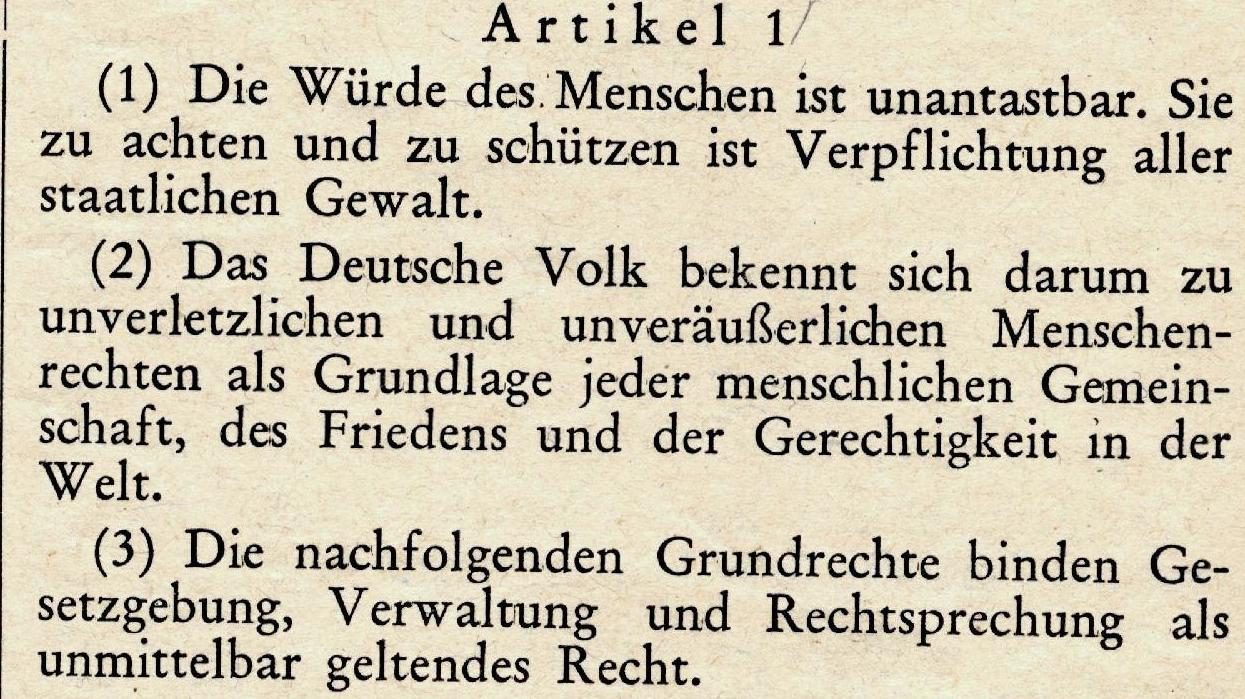
Article 1 is the most important sentence of the Basic Law and it is the answer to many questions: human dignity is inviolable, and to respect and protect it is the duty of all state power.
Article 2: everybody has the right to the free development of their personality and to life and physical integrity, as long as they do not violate the rights of others.
The death penalty is abolished (Article 102). Torture is forbidden.
The rights of the Basic Law apply to all people in Germany, and some (the “Deutschenrechte”, such as the freedom of assembly) apply only to Germans.
These rights are directly applicable law: a person can go to court to defend them, up to the Federal Constitutional Court.
Exam tip: If a question asks about the most important basic right or the first article: Article 1, human dignity.
Key words you will meet in the questions
die Würde des Menschen
human dignity
unantastbar
inviolable
das Grundrecht
a fundamental right
die Todesstrafe
the death penalty
die körperliche Unversehrtheit
physical integrity
Part 2 of 5
The freedoms
Several articles protect the freedoms of the person. Learn the main ones with the number of the article.
Article 4: freedom of faith, conscience and religious belief. Everybody can follow a religion or none, and there is no state church.
Article 5: freedom of opinion, of the press, of art and of science. There is no censorship, but the freedom has limits, for example hate speech (Volksverhetzung) and insults are punished.
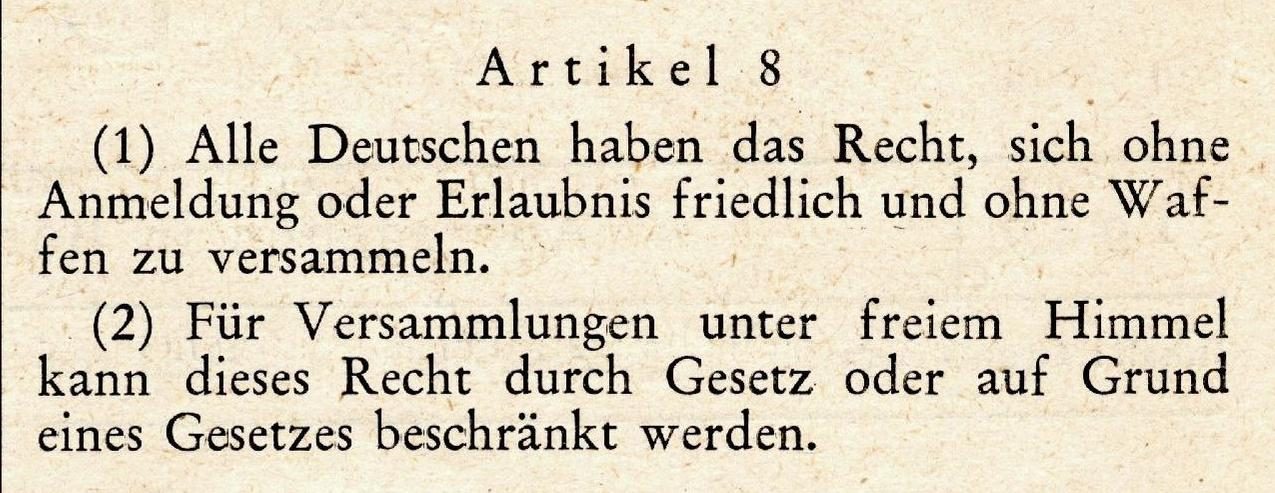
Article 8: freedom of assembly (Versammlungsfreiheit), peaceful and without weapons. Article 9: freedom of association: everybody can form associations, unions and parties.
Article 10: the secrecy of letters, post and telecommunications. Article 13: the inviolability of the home. Article 11: freedom of movement in the whole federal territory.
Article 12: freedom to choose an occupation. Article 16a: persons who are politically persecuted have the right of asylum.
Key words you will meet in the questions
die Meinungsfreiheit
freedom of opinion
die Pressefreiheit
freedom of the press
die Religionsfreiheit
freedom of religion
die Versammlungsfreiheit
freedom of assembly
das Asylrecht
the right of asylum
Part 3 of 5
Equality and protection from discrimination
Article 3 says that all people are equal before the law. Equality between women and men is a question of every year.
Women and men have equal rights (Gleichberechtigung). The state works for the real enforcement of this equality.
Nobody may be disadvantaged or favoured because of sex, descent, race, language, homeland, origin, faith, religious or political opinions, or disability.
The General Equal Treatment Act (AGG) forbids discrimination at work and when renting a flat or buying goods and services.
Marriage and family are under the special protection of the state (Article 6). Marriage needs the free consent of both persons; a forced marriage is a crime. Violence in the family is punished.
Same-sex couples can marry since 2017, and women have had the right to vote since 1918.
Key words you will meet in the questions
die Gleichberechtigung
equal rights (of women and men)
die Diskriminierung
discrimination
vor dem Gesetz gleich
equal before the law
die Zwangsheirat
forced marriage
das Wahlrecht
the right to vote
Part 4 of 5
The courts and the Federal Constitutional Court
The judges are independent and are bound only by the law. Nobody, not even the government, can tell a judge how to decide.
The Federal Constitutional Court (Bundesverfassungsgericht) in Karlsruhe checks that laws agree with the Basic Law. Citizens can complain to it if they think the state violated a basic right (Verfassungsbeschwerde).
Ordinary courts judge civil and criminal cases: Amtsgericht, Landgericht, Oberlandesgericht and, at the top, the Federal Court of Justice (Bundesgerichtshof), also in Karlsruhe.
There are special courts for work (Arbeitsgericht), for social matters (Sozialgericht), for the administration (Verwaltungsgericht) and for tax matters (Finanzgericht).
Everybody has the right to be heard by a court, to a lawyer, and to a fair trial; a person is innocent until proved guilty. The police must follow the law.
The emergency numbers are 110 for the police and 112 for the fire brigade and the ambulance.
Exam tip: Karlsruhe = Bundesverfassungsgericht and Bundesgerichtshof. 110 police, 112 fire and ambulance.
Key words you will meet in the questions
das Bundesverfassungsgericht
the Federal Constitutional Court
der Richter / die Richterin
judge
die Verfassungsbeschwerde
a constitutional complaint
unabhängig
independent
der Rechtsanwalt
lawyer
Part 5 of 5
Rights come with duties
The Basic Law protects your freedom, and it also expects that you respect the law and the rights of others.
Everybody must obey the law and pay taxes and contributions to the social insurance according to their income.
School attendance is compulsory (Schulpflicht): children must go to school from the age of about six, and parents cannot keep them at home for religious or other reasons.
Voting is a right and a civic duty, but there is no legal obligation. Citizens can be called as lay judges (Schöffen).
The compulsory military service was suspended in 2011. Property obliges: its use must serve the common good (Article 14).
Key words you will meet in the questions
die Schulpflicht
compulsory schooling
die Steuer
tax
die Pflicht
duty
der Schöffe
a lay judge
die Wehrpflicht
compulsory military service (suspended)
Remember for the exam
Article 1: human dignity is inviolable. The death penalty is abolished.
Freedoms: faith (Art. 4), opinion and press (Art. 5), assembly (Art. 8), association (Art. 9); asylum (Art. 16a).
Women and men have equal rights (Art. 3); discrimination and forced marriage are forbidden.
Bundesverfassungsgericht, Karlsruhe, protects the basic rights; judges are independent; 110 and 112.
Now practise this topic
Reading is the first step. Questions show you what you already know.
Study the questions on this topic
Every question of the bank on this topic, with its answer. Check yourself and mark what you do not know yet.