Spain is a single State, but it is not centralised. The Constitution gives the regions the right to govern themselves, and the country is divided into autonomous communities, provinces and municipalities. This is one of the most typical topics of the CCSE.
Learn the numbers (17 communities, 50 provinces, two autonomous cities), the name and role of each level, and the languages.
Part 1 of 4
The autonomous communities
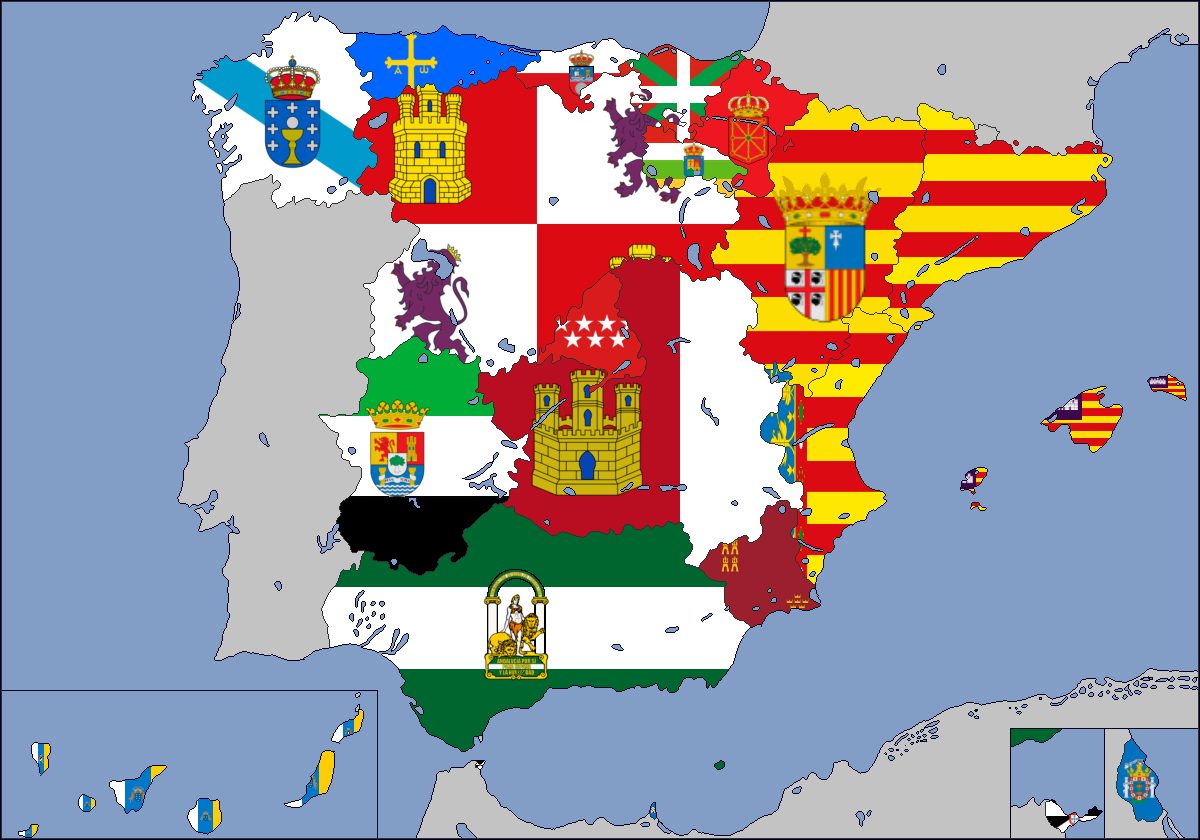
Spain is made up of 17 autonomous communities (comunidades autónomas) and two autonomous cities, Ceuta and Melilla, in the north of Africa.
The communities are Andalucía, Aragón, Asturias, the Balearic Islands, the Canary Islands, Cantabria, Castilla-La Mancha, Castilla y León, Cataluña, the Comunitat Valenciana, Extremadura, Galicia, Madrid, Murcia, Navarra, the País Vasco and La Rioja.
Each community has a Statute of Autonomy (Estatuto de Autonomía), which is its basic law and is approved by the Cortes Generales.
Each has its own parliament, government and president, and its own powers, for example in health, education and social services. Some communities, such as the Basque Country and Navarra, have a special tax system.
The State keeps the powers that concern everybody: foreign affairs, defence, the nationality and the basic laws.
The autonomous communities are not independent states: the Constitution declares the indivisible unity of the Spanish nation.
Exam tip: 17 communities + 2 autonomous cities. Both numbers appear in the test.
Key words you will meet in the questions
comunidad autónoma
autonomous community
Estatuto de Autonomía
Statute of Autonomy
ciudad autónoma
autonomous city (Ceuta, Melilla)
competencias
powers / responsibilities
gobierno autonómico
regional government
Part 2 of 4
The provinces
The communities are divided into provinces. Spain has 50 provinces; the autonomous cities of Ceuta and Melilla are not in a province.
A province is a group of municipalities. It is governed by a provincial council (Diputación Provincial). In the islands there are island councils instead (cabildos in the Canaries, consells in the Balearic Islands).
Several communities have only one province: for example Madrid, Murcia, Navarra, Asturias, Cantabria, La Rioja and the Balearic Islands. That is why they are called “uniprovincial”.
Andalucía is the community with the most provinces (eight), and Castilla y León has nine provinces. Provinces are also used to elect the senators and the deputies.
Most provinces are named after their capital city, such as Sevilla, Zaragoza or Valencia.
Key words you will meet in the questions
provincia
province
Diputación Provincial
provincial council
capital de provincia
provincial capital
cabildo
island council (Canary Islands)
Part 3 of 4
The municipalities
The municipality (municipio) is the smallest and closest level of government. There are more than eight thousand municipalities in Spain.
Each municipality is governed by an Ayuntamiento (town hall), made up of the mayor (alcalde or alcaldesa) and the councillors (concejales).
The councillors are elected by the residents in municipal elections every four years, and the councillors elect the mayor.
The town hall takes care of local things: streets and lighting, rubbish collection, local police, markets, parks, local transport and many social services.
To register where you live you go to your town hall and ask for the padrón municipal (the register of inhabitants). The padrón is needed for health care, school places and many procedures.
Key words you will meet in the questions
ayuntamiento
town hall / local council
alcalde / alcaldesa
mayor
concejal
town councillor
padrón municipal
register of inhabitants
empadronarse
to register as a resident
Part 4 of 4
The languages of Spain
Spanish (castellano) is the official language of the whole State. Other languages are also official in their own communities.
Catalan is co-official in Cataluña, the Balearic Islands and the Comunitat Valenciana (where it is called valenciano).
Galician (gallego) is co-official in Galicia, and Basque (euskera) in the País Vasco and in part of Navarra.
Aranese (aranés), a variety of Occitan, is also official in the Val d’Aran in Cataluña.
Every Spaniard has the duty to know Castilian, and the right to use it; the other languages are a cultural heritage that must be respected and protected (Article 3).
Key words you will meet in the questions
castellano
Castilian (Spanish)
catalán
Catalan
gallego
Galician
euskera / vasco
Basque
cooficial
co-official
Remember for the exam
17 autonomous communities and 2 autonomous cities (Ceuta and Melilla); 50 provinces; more than 8,000 municipalities.
Each community has a Statute of Autonomy, its own parliament and government, and powers such as health and education.
The municipality is governed by the Ayuntamiento: the mayor and the councillors, elected every four years.
Register where you live at the town hall (padrón municipal).
Castilian is the official language; Catalan, Galician, Basque and Aranese are co-official in their areas.
Now practise this topic
Reading is the first step. Questions show you what you already know.
Study the questions on this topic
Every question of the bank on this topic, with its answer. Check yourself and mark what you do not know yet.